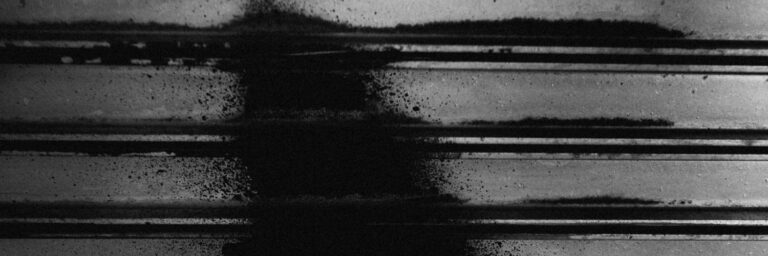
Form precedes meaning

Form precedes meaning

There is no objective truth in photography. The image is never more than a fragment of reality, a truncated, momentary, and incomplete point of view. The image is subjective, and its truth is always multiple, like that of the observer, or unfathomable, like that of the artist.

If there is such a thing as a “photographic truth”, it is to be found in its fundamental elements: light, composition, and optical device.

I have therefore attempted, inspired by the simplified form of the haiku and the mechanical honesty of Man Ray’s rayographs, to imagine an aesthetic that would stem solely from the photographic form itself. Read
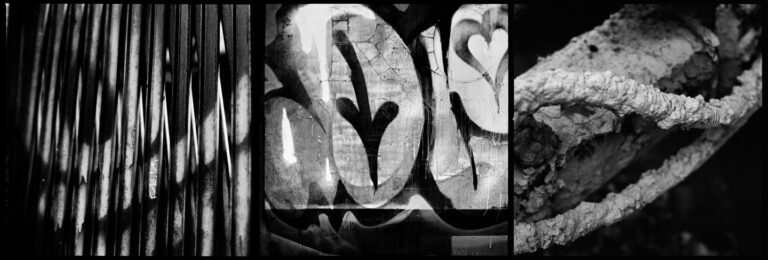

Déjà vu, memory and photography

Déjà vu, memory and photography
Déjà vu — Photography as a readymade memory

“Déjà vu” is a brief experience during which time seems to have been put into a loop.

The moment takes place before our eyes, in present time, but it seems in every way identical to a memory, to an event that we have already experienced but whose origin we are nevertheless unable to clearly identify.

Science suggests that this phenomenon is due to a simple switching error in the cerebral cortex¹. But fortunately, the world is not limited to that of scientific knowledge; thus, I like to imagine that there exists a dimension parallel to ours, a world where the entirety of time and space can be simultaneously accessible in a non-linear way. Déjà vu would then only be a slippage between these two dimensions, a “glitch” of space-time which would temporarily give us access to this other chronology. Read


Abstraction and photography

Abstraction and photography
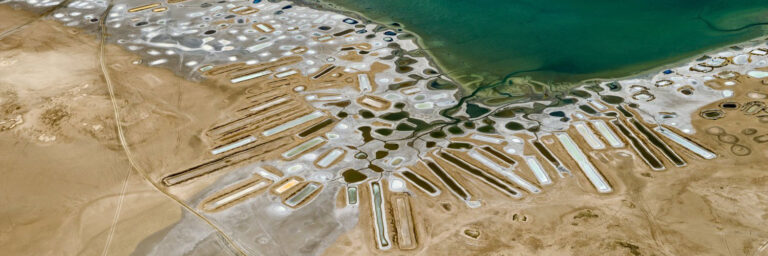
Salt Ponds #2a, Near Fatick, Senegal, 2019 (detail) — © 2019 Edward Burtynsky

Of course, the photographic image cannot, as painting does, aspire to pure abstraction. This is due to its very definition: it is a mechanism that allows the fixing of the image of a real object¹. An optical device, such as a lens or a pinhole, captures ambient light and projects it onto a photosensitive surface. This surface — whether it is a film negative or a digital sensor — reacts to varying degrees depending on the intensity of the received light; in this way, it can record the image momentarily projected by the lens.

Abstract painters did not seek to deny reality, but rather to advance painting by freeing it from the formal constraints of realism. They developed a vocabulary proper to the medium by reducing it to its essential elements: matter, form, and color. Painting no longer owed anything to the rest of the world: it had value in and of itself. This way of thinking underlies all modern art of the twentieth century. Read


Cosmology of Light

Cosmology of Light
Entangled photons — The study of light is at the heart of quantum physics

Light is to a photographer the substance that gives shape to the world.”

The story has it that on the first day, the Divine created all matter. He then wanted to create light, so he could sit back and admire the work he had just accomplished.

Light is what makes our world visible. It outlines rocky capes, bathes valleys, and sparkles at the tip of waves. It lends its warmth to autumn, and gets pale in the winter. It wakes us up in the morning, and takes us back to sleep at night.

I sometimes find myself in proper awe of these celestial spectacles. I am reminded that light isn’t of a terrestrial nature, it is a cosmic force. It reaches us all the way from a star, that fireball hanging in the sky a hundred fifty million kilometers away. Without its warmth and clarity, life wouldn’t be possible on Earth, and of course, there would be no photography.

Over the course of my adventures, I have familiarized myself with its many moods, and made it into an ally. Light is the muse, the source, the carrier, and the one from which, when it disappears, I await the return.
Read


Pushes and pulls

A person’s work can only reflect their own personal drives, hesitations and fears — all of the different internal pulls that will balance each other to form an individual’s own approach to life. For me, the best things in life involve sharing. As a mere mortal I am not completely selfless, but ultimately, my goal is to leave behind images that will survive my own ephemerality. I wish for these images to be meaningful enough in themselves to be able to connect with the people of the future.

You are taking a real picture in real time no matter how conceptual it is. ”

Annie Leibovitz, from Taschen’s “Annie’s Album” interview


Analog callings

Analog callings
Film photography — Everything that can go wrong will eventually go wrong

In today’s virtualized world, light-sensitive film has in itself become somewhat of a myth. It is a fragile object, a mysterious anachronism seemingly endowed with time-traveling powers.

The extra-long lasting flavor

Most of the time, taking photographs on analog film won’t be your wisest, most practical choice. Although the negative is a real, physical object, its qualities are mostly intangible; could this only be a fascination for a certain mystique?

Personally, I simply have more love for the analog rendering of film. One thing is for certain, film doesn’t speak of things that are happening right now. Film is the anti-instantaneous, the extra-long lasting flavor.
Read

© 2026 Rico Michel – All rights reserved